
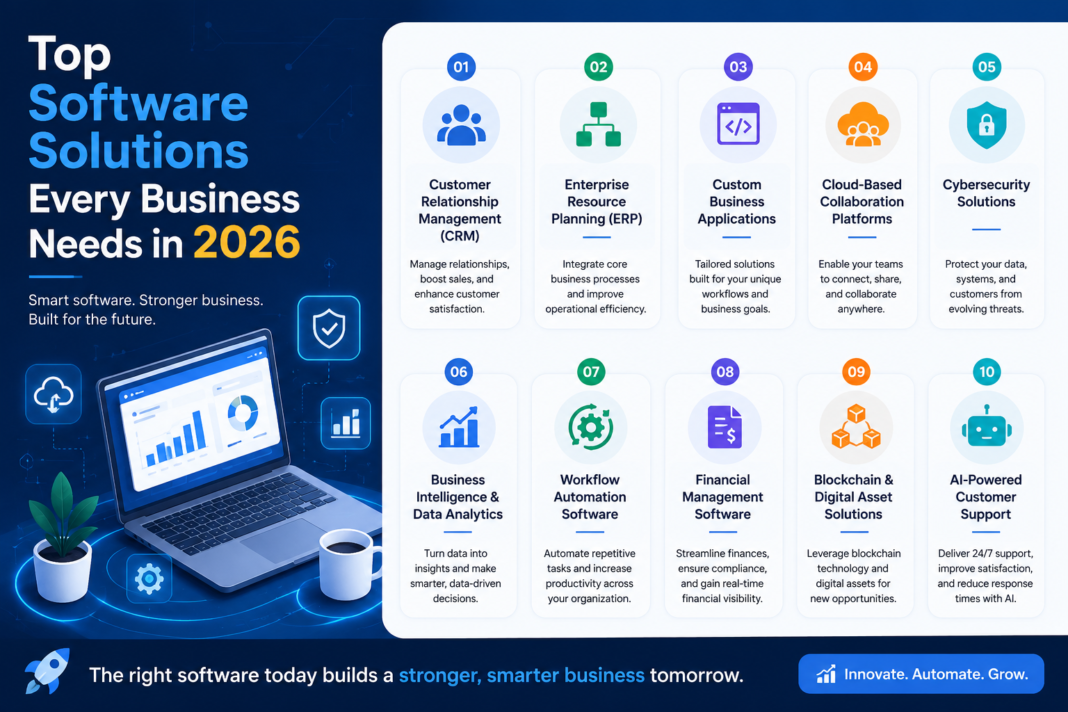
The business landscape is evolving faster than ever, and 2026 is expected to bring even greater technological advancements. Companies that embrace modern software solutions will be better positioned to improve efficiency, enhance customer experiences, and remain competitive in a rapidly changing market. Whether you’re a startup, a growing enterprise, or an established organization, investing in the right technology can significantly impact your long-term success.
From automation and cloud computing to advanced cybersecurity and digital finance, businesses are increasingly relying on software to streamline operations and support sustainable growth. Here are the top software solutions every business should consider in 2026.
1. Customer Relationship Management (CRM) Systems
Building strong customer relationships remains one of the most important factors for business success. A robust CRM system helps organizations manage customer interactions, track sales pipelines, automate follow-ups, and gain valuable insights into customer behavior.
Businesses today expect CRM platforms to do much more than store contact information. Modern systems integrate with marketing tools, customer support platforms, and analytics software, creating a unified view of every customer journey.
Partnering with a reliable crm software development company allows businesses to create tailored CRM platforms that align with unique workflows instead of relying solely on generic, off-the-shelf solutions. Customized CRM systems improve productivity while providing a more personalized customer experience.
2. Enterprise Resource Planning (ERP) Software
ERP software continues to be a cornerstone for businesses seeking operational efficiency. It combines multiple business functions—including finance, procurement, inventory management, human resources, and supply chain operations—into a single centralized platform.
With AI-powered analytics becoming more common in ERP systems, companies can make faster and more accurate decisions using real-time data. Automated reporting and predictive insights reduce manual effort while helping organizations identify growth opportunities.
As businesses scale, ERP software ensures departments remain connected, reducing communication gaps and improving collaboration across the organization.
3. Custom Business Applications
Every business has unique operational requirements that cannot always be addressed by standard software packages. This is why many organizations are investing in custom software solutions designed specifically for their processes and goals.
Custom applications offer greater flexibility, better integration with existing systems, and improved scalability. Instead of adapting business processes to fit software limitations, organizations can build applications that support their exact workflows.
Whether it’s an internal management portal, customer-facing application, or workflow automation platform, customized software provides long-term value by increasing efficiency and reducing unnecessary complexity.
4. Cloud-Based Collaboration Platforms
Remote and hybrid work models continue to shape modern workplaces. Businesses need cloud collaboration platforms that enable employees to communicate, share files, manage projects, and collaborate regardless of location.
These platforms help improve productivity by providing secure access to documents, video conferencing, messaging, and workflow management in one environment. Cloud technology also reduces infrastructure costs while improving business continuity through automatic backups and scalable resources.
Organizations that prioritize collaboration tools can respond faster to changing business demands while maintaining seamless communication across distributed teams.
5. Cybersecurity Solutions
Cyber threats continue to evolve, making cybersecurity one of the highest priorities for businesses in 2026. Companies handle sensitive customer information, financial records, and proprietary business data that require constant protection.
Modern cybersecurity solutions include endpoint protection, identity management, multi-factor authentication, threat detection, encryption, and continuous monitoring. Artificial intelligence is also playing a growing role in identifying suspicious activity before security incidents escalate.
A proactive cybersecurity strategy not only protects business assets but also builds customer trust and helps organizations comply with increasingly strict data privacy regulations.
6. Business Intelligence and Data Analytics
Data has become one of the most valuable business assets. However, collecting information alone is not enough. Organizations need business intelligence tools that transform raw data into meaningful insights.
Modern analytics platforms help businesses monitor performance, identify market trends, forecast future demand, and optimize decision-making. Interactive dashboards provide real-time visibility into key performance indicators, enabling leaders to make informed strategic decisions.
Companies that effectively leverage data analytics gain a competitive advantage by identifying opportunities faster than competitors relying on intuition alone.
7. Workflow Automation Software
Manual and repetitive tasks consume valuable employee time and often lead to human error. Workflow automation software helps businesses streamline routine processes such as invoice approvals, employee onboarding, customer support, document management, and reporting.
Automation improves efficiency while allowing employees to focus on higher-value activities that require creativity and strategic thinking. As artificial intelligence becomes more advanced, automation platforms are becoming increasingly capable of handling complex workflows with minimal human intervention.
Businesses adopting automation often experience faster operations, lower operational costs, and improved service quality.
8. Financial Management Software
Effective financial management remains essential regardless of business size. Modern accounting and finance software helps organizations automate bookkeeping, expense tracking, budgeting, payroll, tax compliance, and financial reporting.
Cloud-based financial platforms also provide real-time visibility into cash flow, allowing businesses to make informed investment and budgeting decisions. Integration with banking systems and payment gateways further simplifies financial operations.
Accurate financial data supports sustainable growth while reducing compliance risks and administrative workload.
9. Blockchain and Digital Asset Solutions
Blockchain technology is moving beyond cryptocurrency into mainstream business applications. Industries such as finance, logistics, healthcare, and supply chain management are increasingly adopting decentralized technologies to improve transparency and security.
Organizations exploring digital finance often work with a trusted defi wallet development company to build secure wallet applications that support decentralized transactions, digital asset management, and blockchain-based financial services. As decentralized ecosystems continue to mature, businesses that invest early may unlock new revenue streams and innovative customer experiences.
10. AI-Powered Customer Support
Customer expectations continue to rise, making responsive support more important than ever. AI-powered customer service platforms enable businesses to provide instant assistance through chatbots, virtual assistants, and intelligent ticket routing.
These systems handle common inquiries around the clock while allowing human support agents to focus on more complex customer issues. AI can also analyze customer conversations to identify recurring problems, helping businesses improve products and services over time.
By combining automation with personalized service, organizations can enhance customer satisfaction while reducing operational costs.
Final Thoughts
Technology is no longer just a support function—it has become a driving force behind business growth and innovation. The right software solutions empower organizations to improve efficiency, strengthen customer relationships, enhance security, and make smarter business decisions.
As 2026 approaches, businesses should evaluate their existing technology stack and identify opportunities for modernization. Investing in scalable, secure, and intelligent software today will prepare organizations for tomorrow’s challenges while creating a strong foundation for long-term success. Companies that embrace digital transformation early will be better equipped to adapt, compete, and thrive in an increasingly technology-driven world.